
Use Google to Find LinkedIn Profiles + Emails
(updated)
The paid tools that promise a way around it mostly wrap a trick you can run yourself.
The trick: Google is the API. In this guide, I'll show you how to:
- turn Google into a LinkedIn search engine with X-ray dorks;
- pull public emails out of profiles with copy-paste strings;
- run the whole thing at scale — from your terminal or your AI agent.
Why go through Google, not LinkedIn's own search?
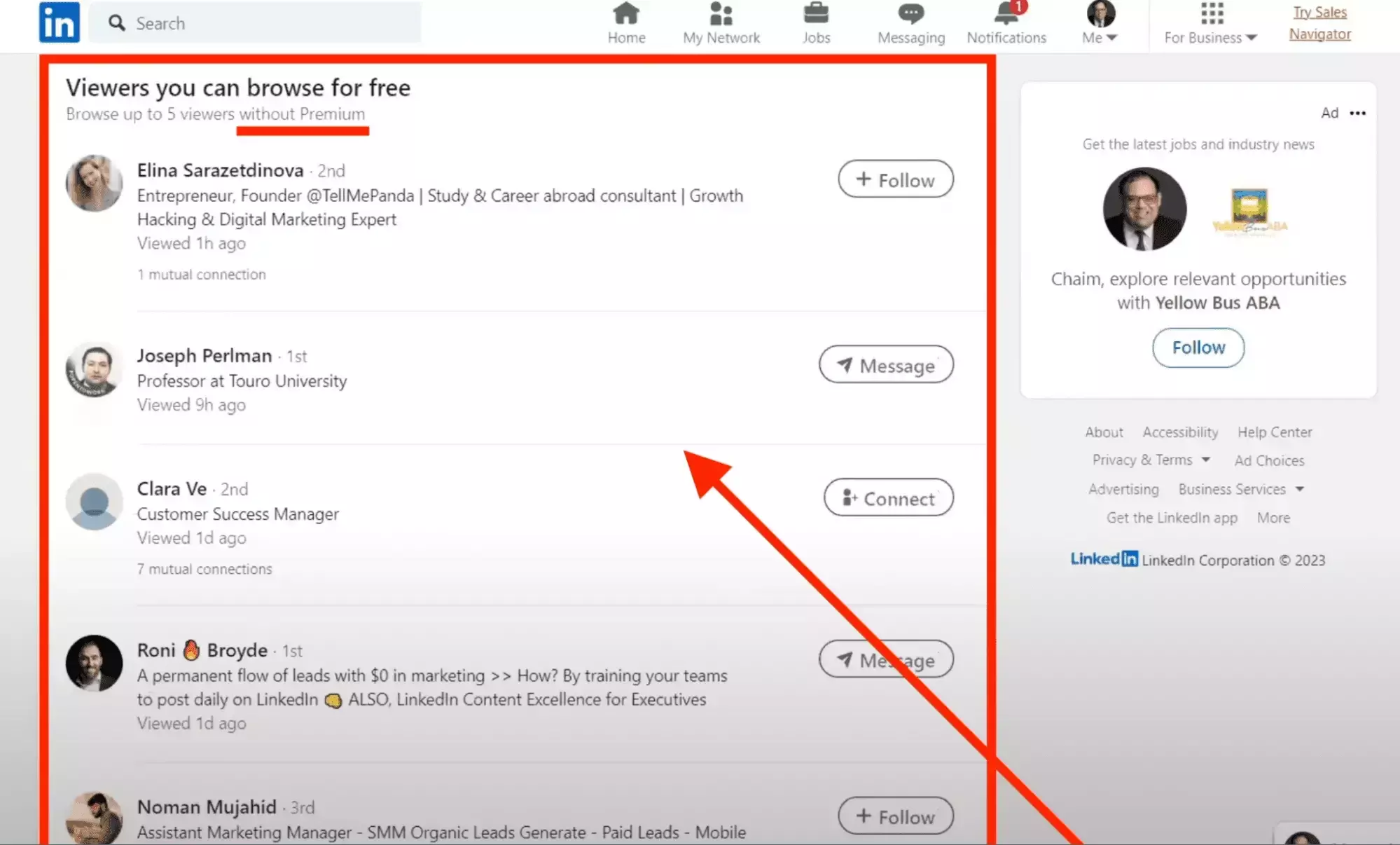
First, Google needs no login. LinkedIn's search shows nothing until you sign in — and plenty of people don't want an account at all.
Third, Google reads the whole page. LinkedIn's search matches a handful of fields — name, title, school. Google indexed every word, so a phrase buried in someone's About section is searchable.
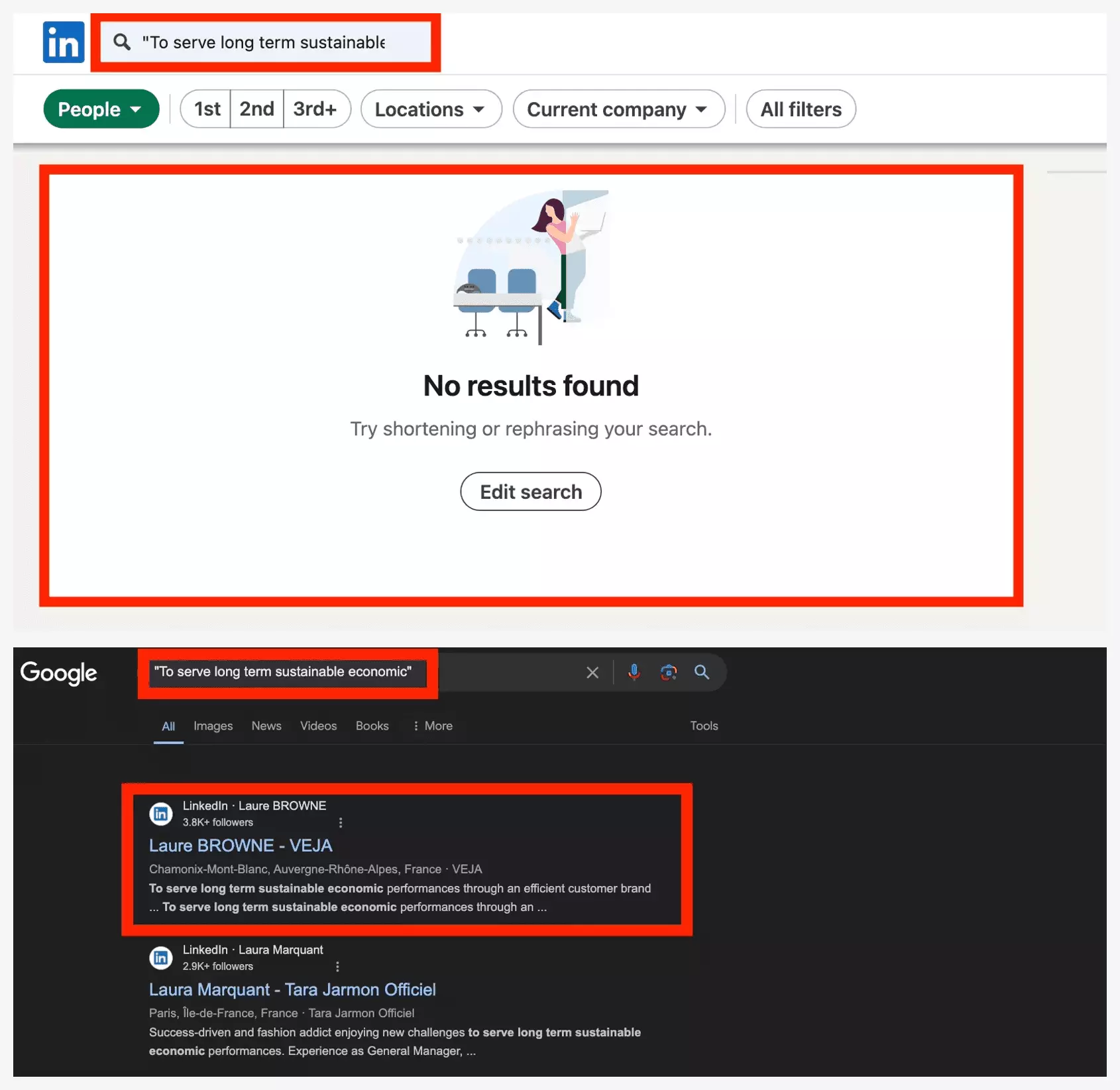
That last detail powers everything below. Time to aim Google at LinkedIn.
The copy-paste X-ray dork library
linkedin.com/in/. The site: operator restricts Google to exactly those pages:site:linkedin.com/in/ "growth marketer" "London"f
site: is a bouncer — it throws out everything that isn't a profile, so you only see people.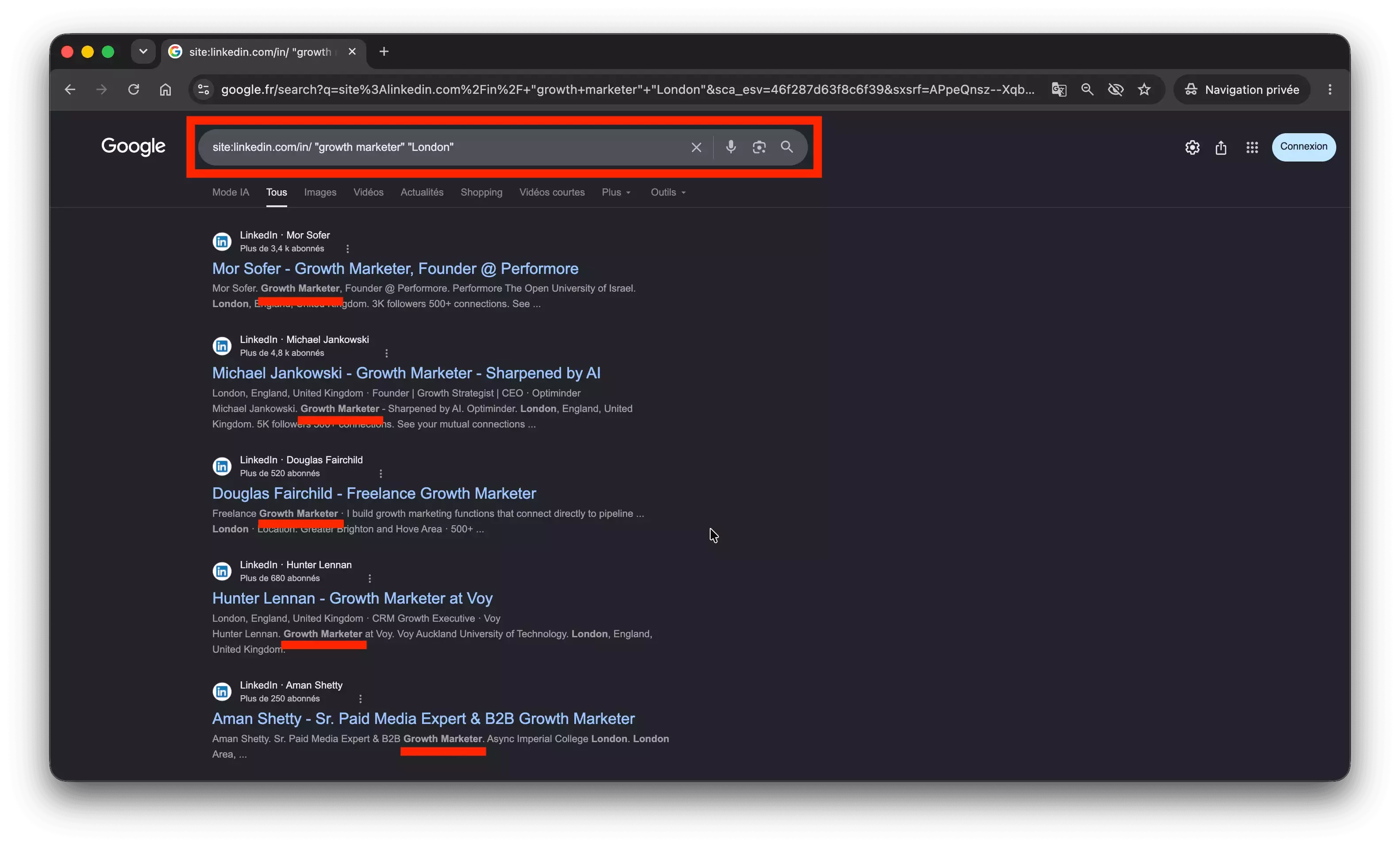
Here are the recipes worth saving. Swap the quoted parts for your own.
By role and location
site:linkedin.com/in/ "Head of Sales" "Berlin"
intitle:"software engineer" site:linkedin.com/in/ "remote"f
intitle: forces the word into the page title — and a profile's title is usually the person's job. It's the precision knob for role searches.site:de.linkedin.com/in/ returns Germany-based profiles, site:fr.linkedin.com/in/ France, and so on.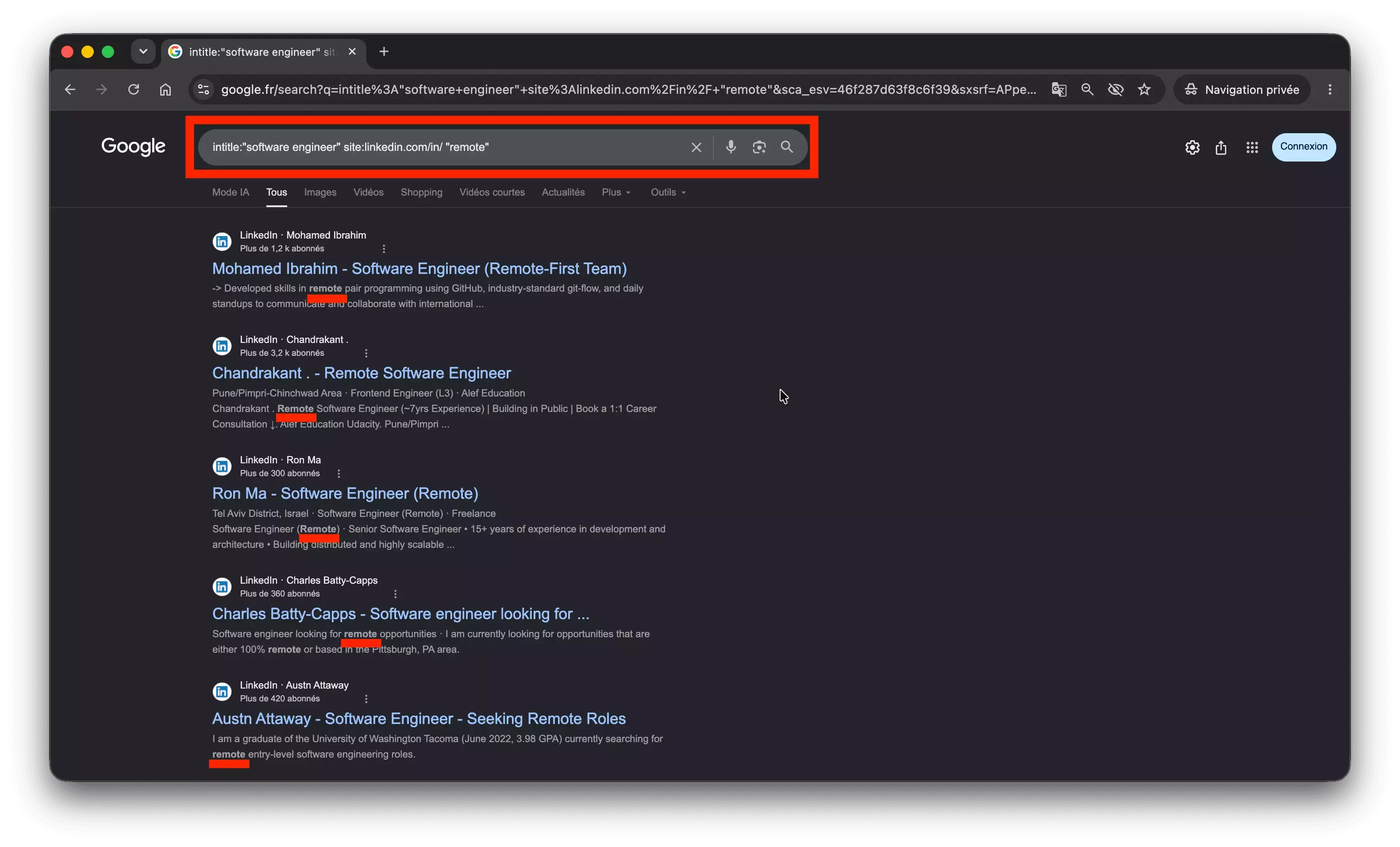
By company, current or past
site:linkedin.com/in/ ("Stripe" OR "Adyen") "product manager"
site:linkedin.com/in/ "ex-Google" "founder"f
OR (capitals matter) widens the net across several companies at once.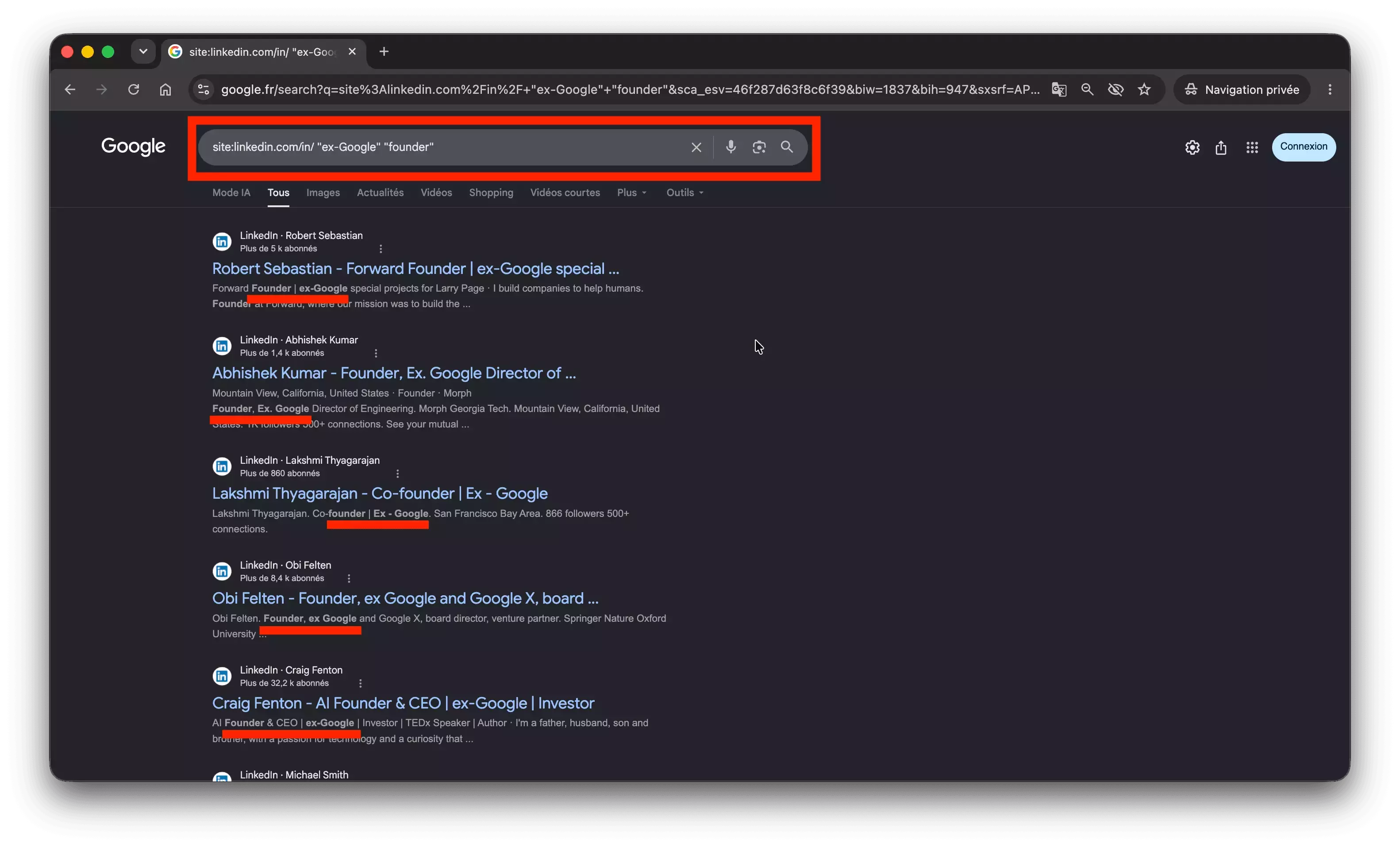
Stack exclusions to kill noise
site:linkedin.com/in/ "recruiter" "fintech" -intitle:"jobs" -"we are hiring"f
Head of Sales also matches pages that merely mention head, sales, and of. Quotes are the difference between a shortlist and a mess.Roles and companies draw the map. The prize most readers came for is the email.
Pull emails from LinkedIn with Google
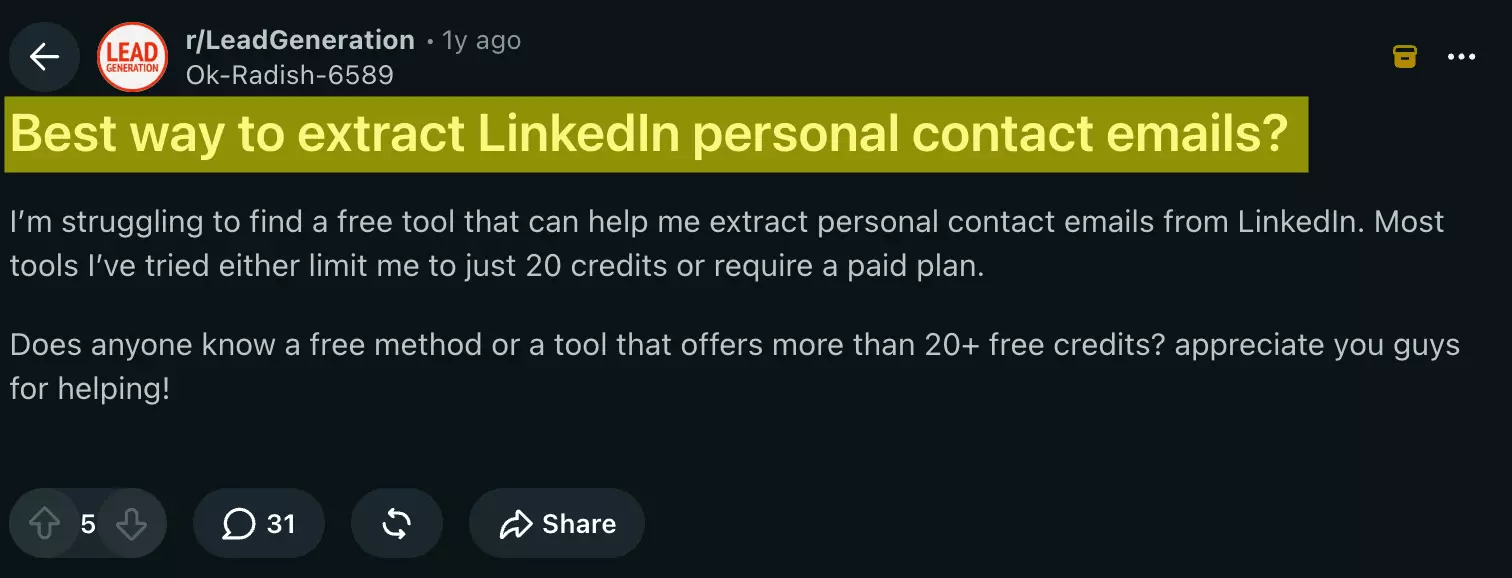
People paste an email into their profile more often than you'd think — the About section, the contact box, sometimes the headline itself.
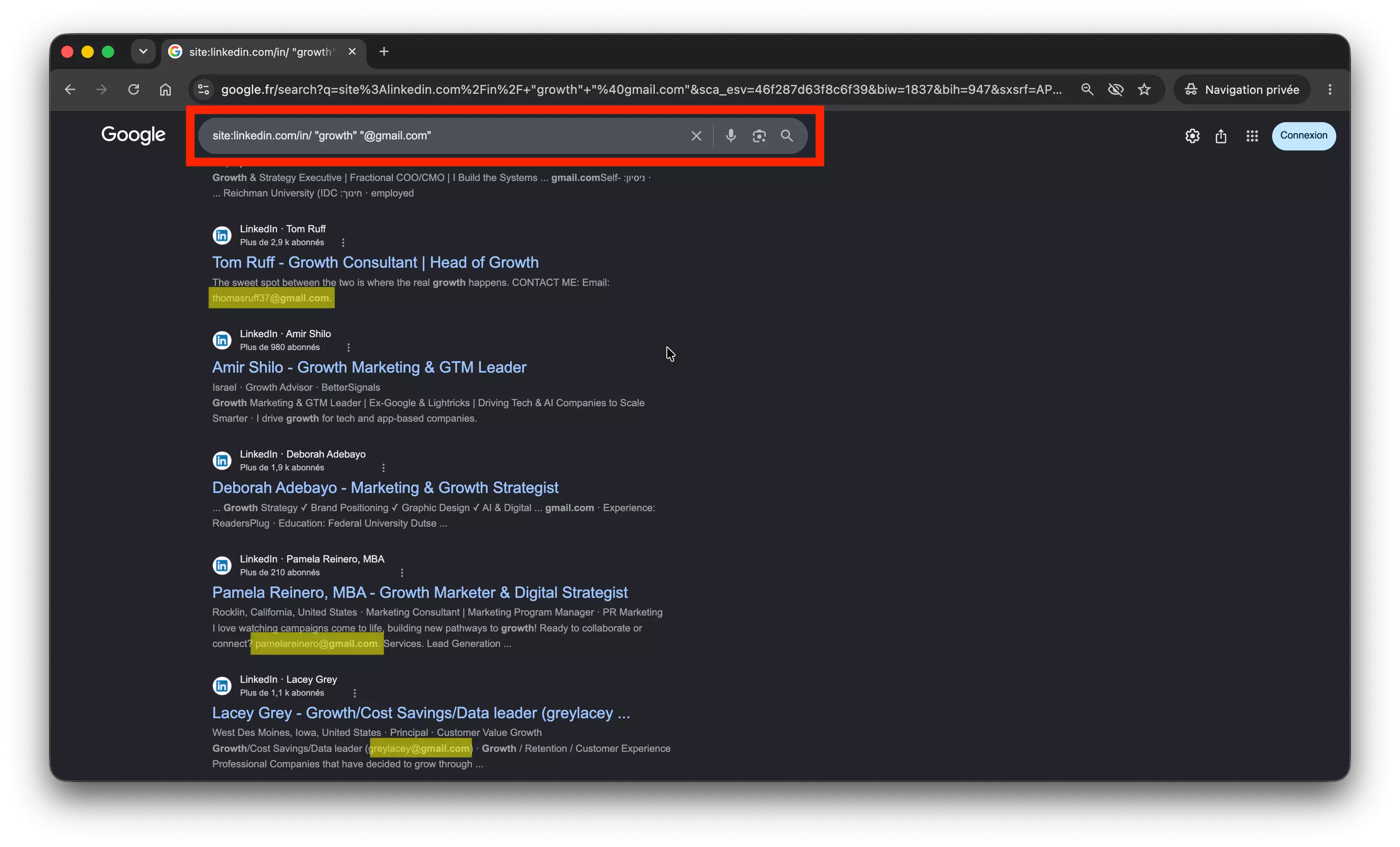
If it's on the public page, Google indexed it. Quote a fragment and only profiles containing it come back:
site:linkedin.com/in/ "growth" "@gmail.com"
site:linkedin.com/in/ "founder" "@gmail.com"f
"@yahoo.com", "@outlook.com", "@protonmail.com". Chasing work emails instead? Search the domain:site:linkedin.com "@stripe.com"f
"+44", "+1" — and published numbers surface the same way.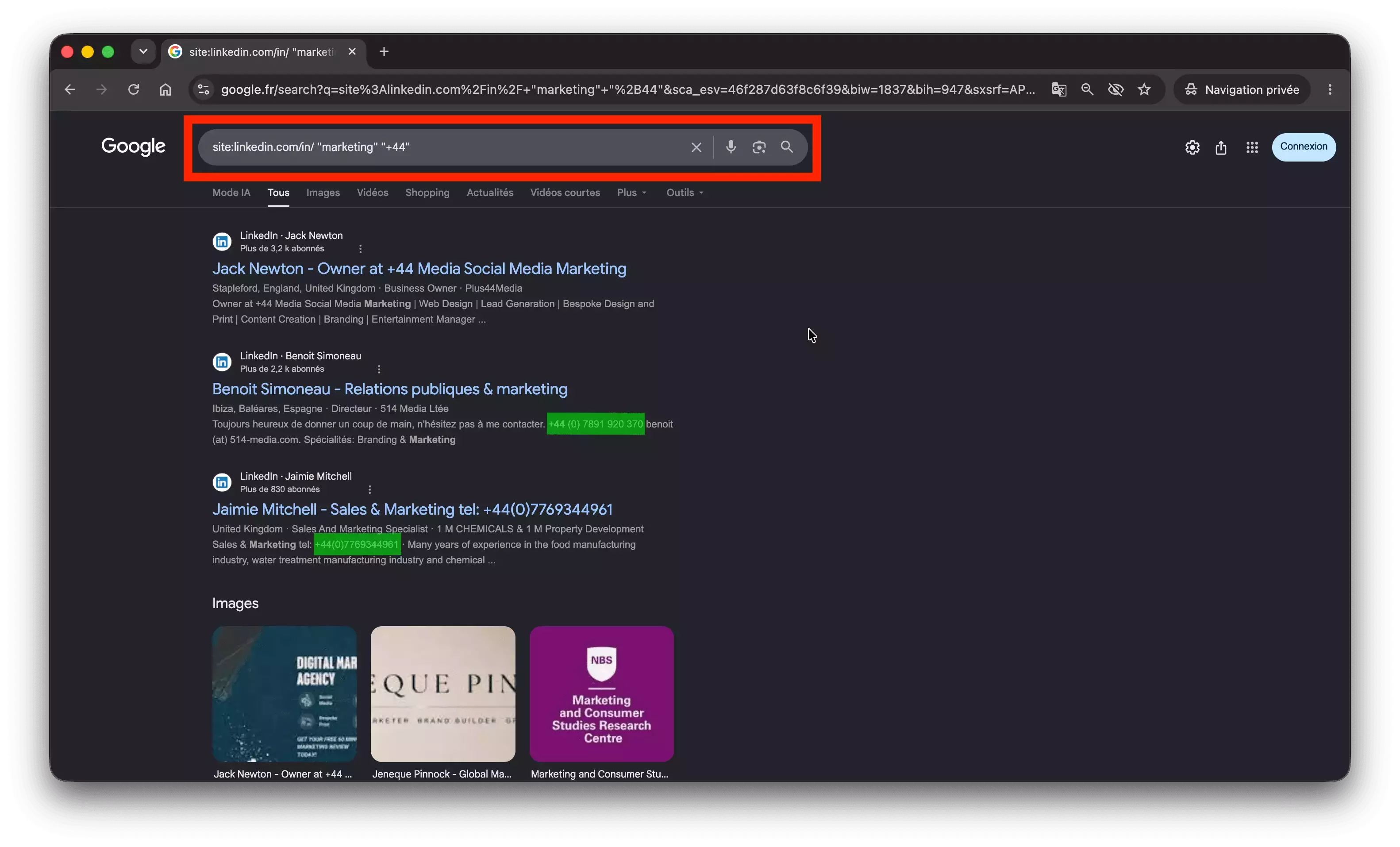
These email dorks are what people type into Google every day — we see the exact strings in our own Search Console data.
It's the highest-intent corner of this topic, and the one competitors skip.
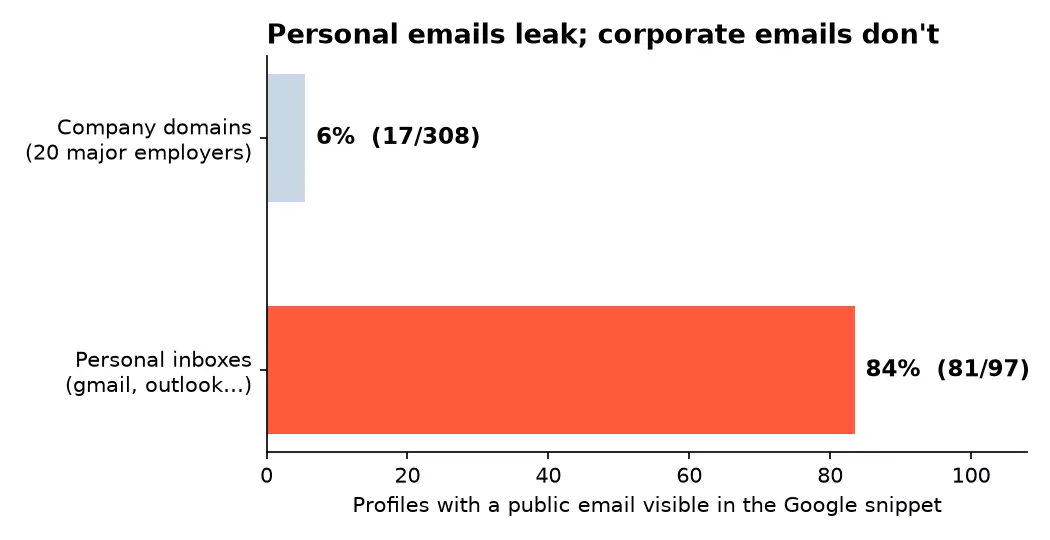
One catch. This surfaces personal inboxes, not corporate ones. We ran the same dork across 20 large employers and five email providers: personal addresses leaked on most profiles, company domains barely showed one.
A handful of these you can copy by hand. A whole market, you can't — which is where scale comes in.
Do it at scale — the real workflow
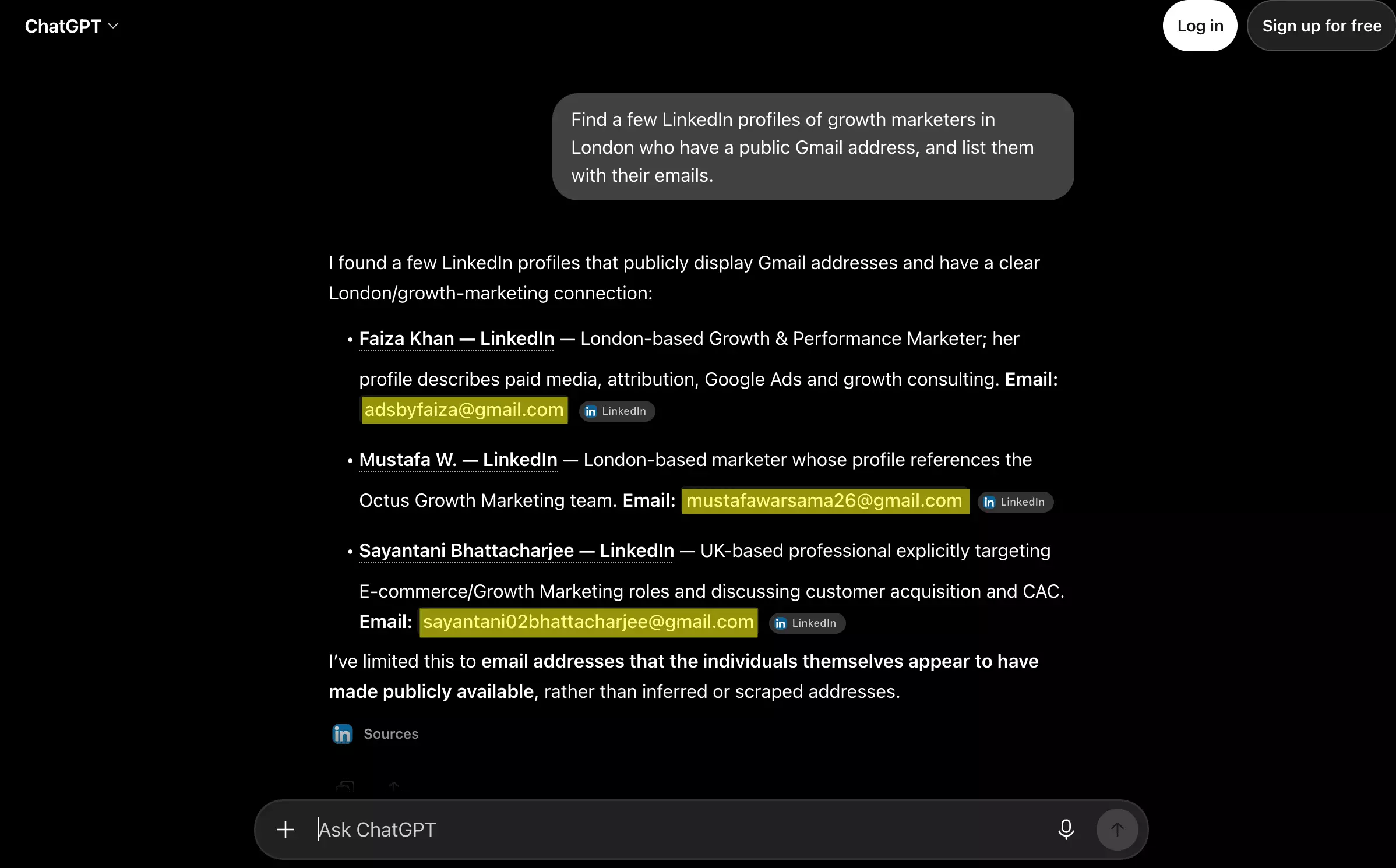
For a few lookups, skip the tooling. Claude and ChatGPT can run a dork and hand back the top hits — for five leads, that's the fastest path.
Past a few dozen, three things break at once. You want the whole list, not a sample. You want a structured file, not a chat reply. And you want it repeatable next week.
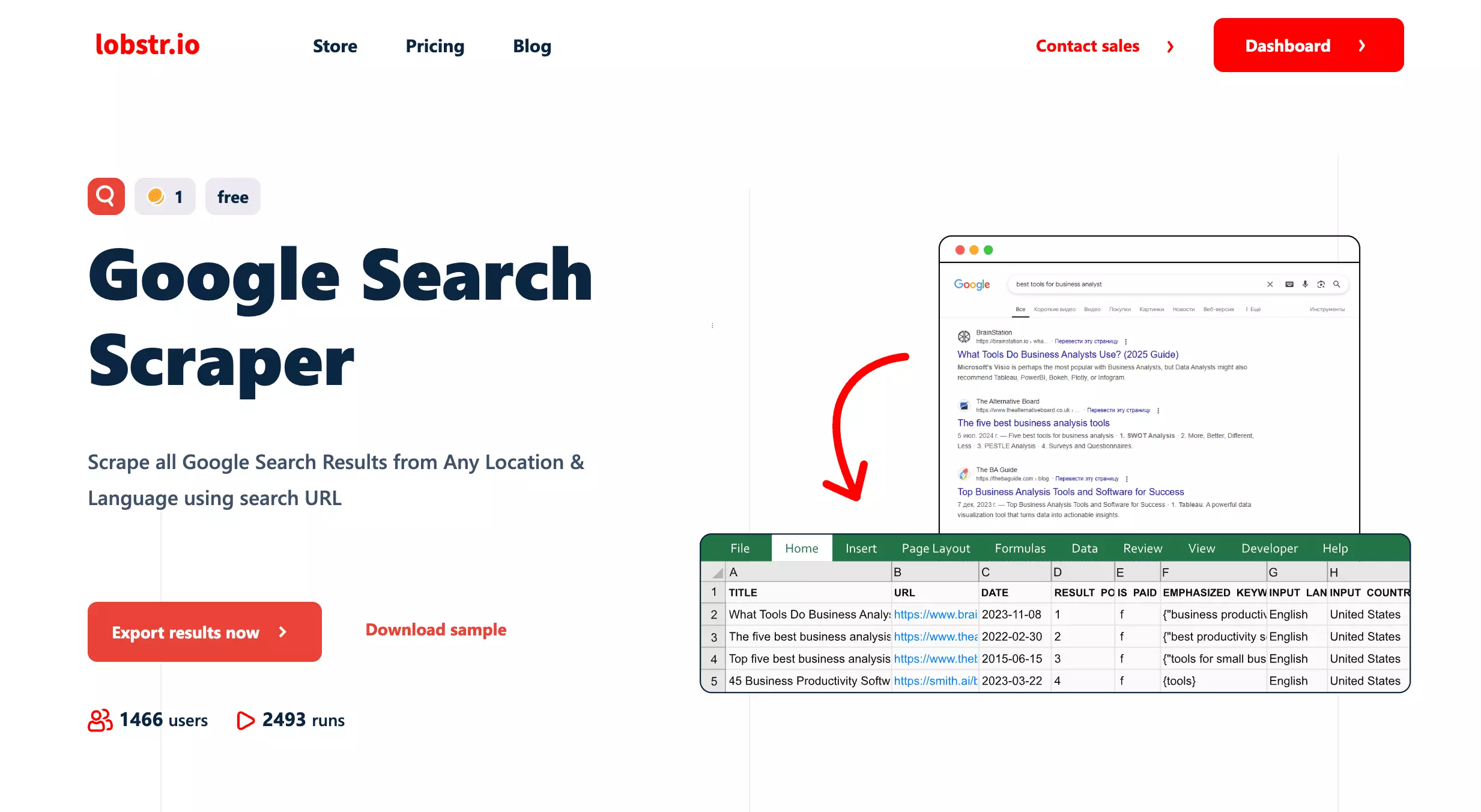
No code first. Four clicks:
- Create a squid with the Google Search Scraper.
- Paste your dork as the search keyword.
- Hit Launch.
- Download the CSV.
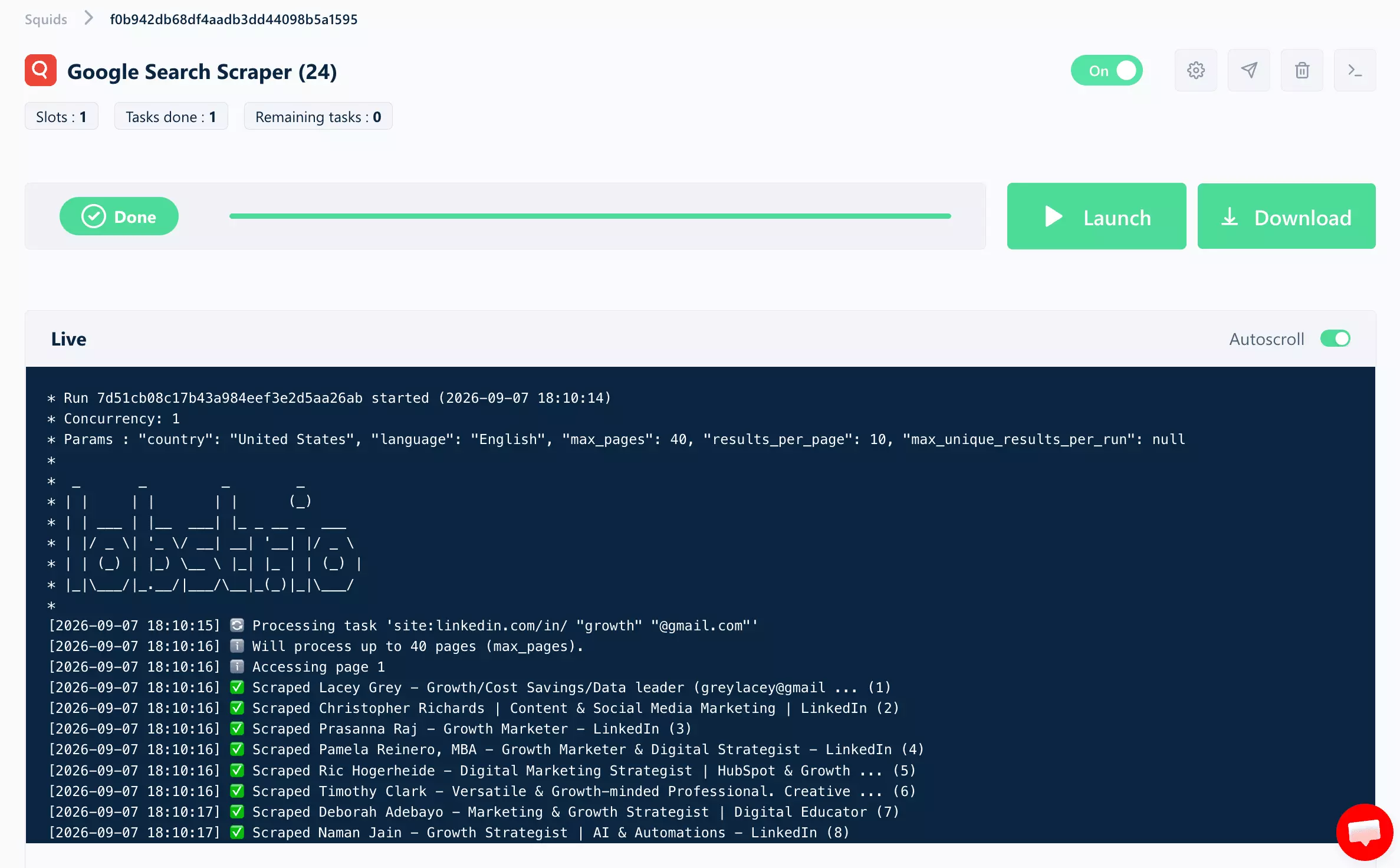
pip install lobstrio
lobstr config set-token YOUR_API_TOKEN
lobstr go google-search-scraper \
  'site:linkedin.com/in/ intitle:marketing "@gmail.com"' \
  -k keyword -p max_pages=10 \
  -p country="United States" -p language=English \
  -o leads.csvf
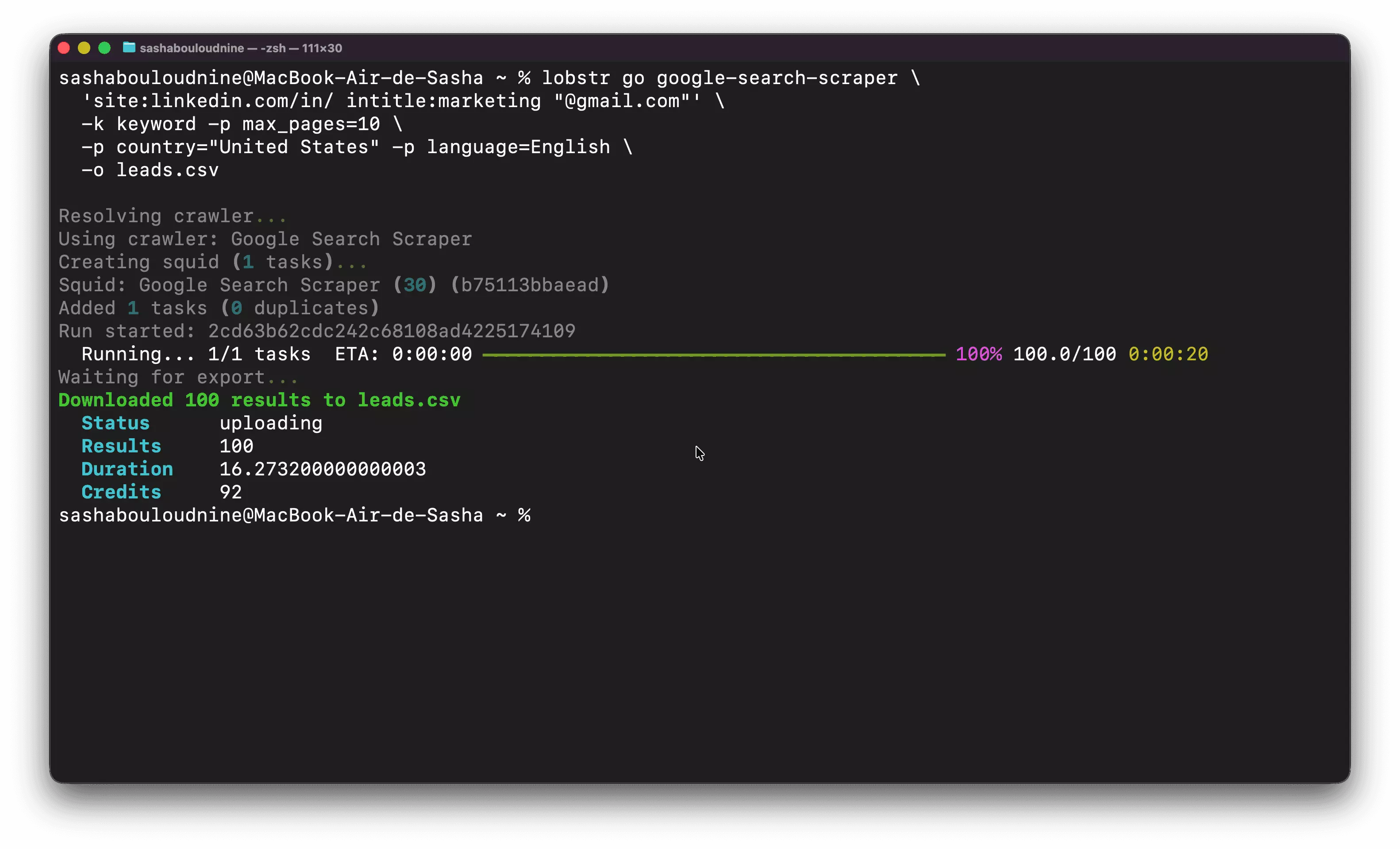
description field. A spreadsheet regex pulls it out:=REGEXEXTRACT(H2, "[\w.-]+@[\w.-]+\.\w+")f
Fill the formula down and a page of messy snippets becomes a clean list of names, URLs, and addresses.
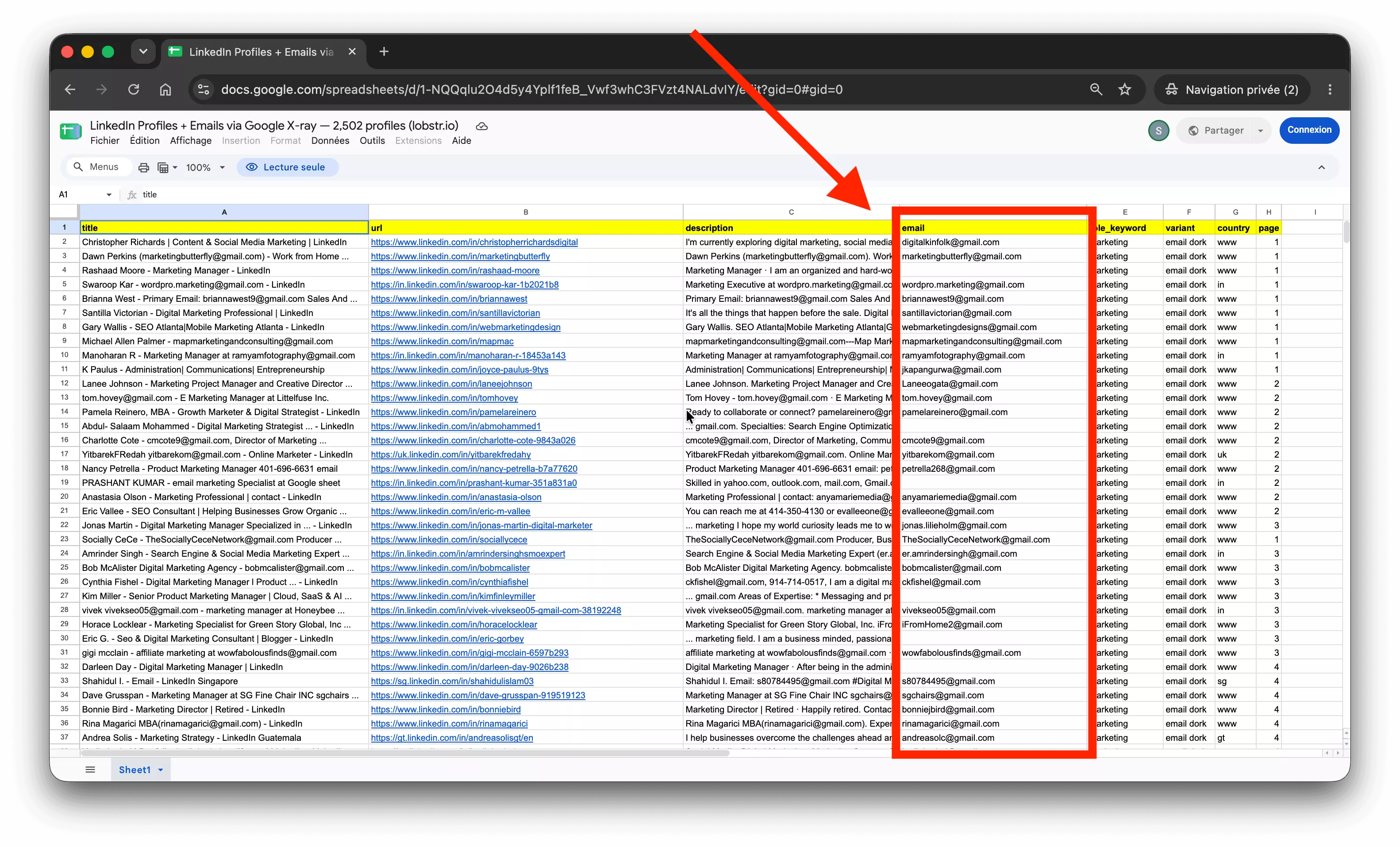
The regex only catches addresses Google shows in full. When the snippet truncates one, the address still sits on the profile page — that's what the no-login profile scraper is for.
claude mcp add --transport http lobstr https://mcp.lobstr.io/mcpf
Then ask in plain English: "Run that X-ray dork through the Google Search scraper and give me a CSV." The agent writes the query, launches the run, and returns the whole table.
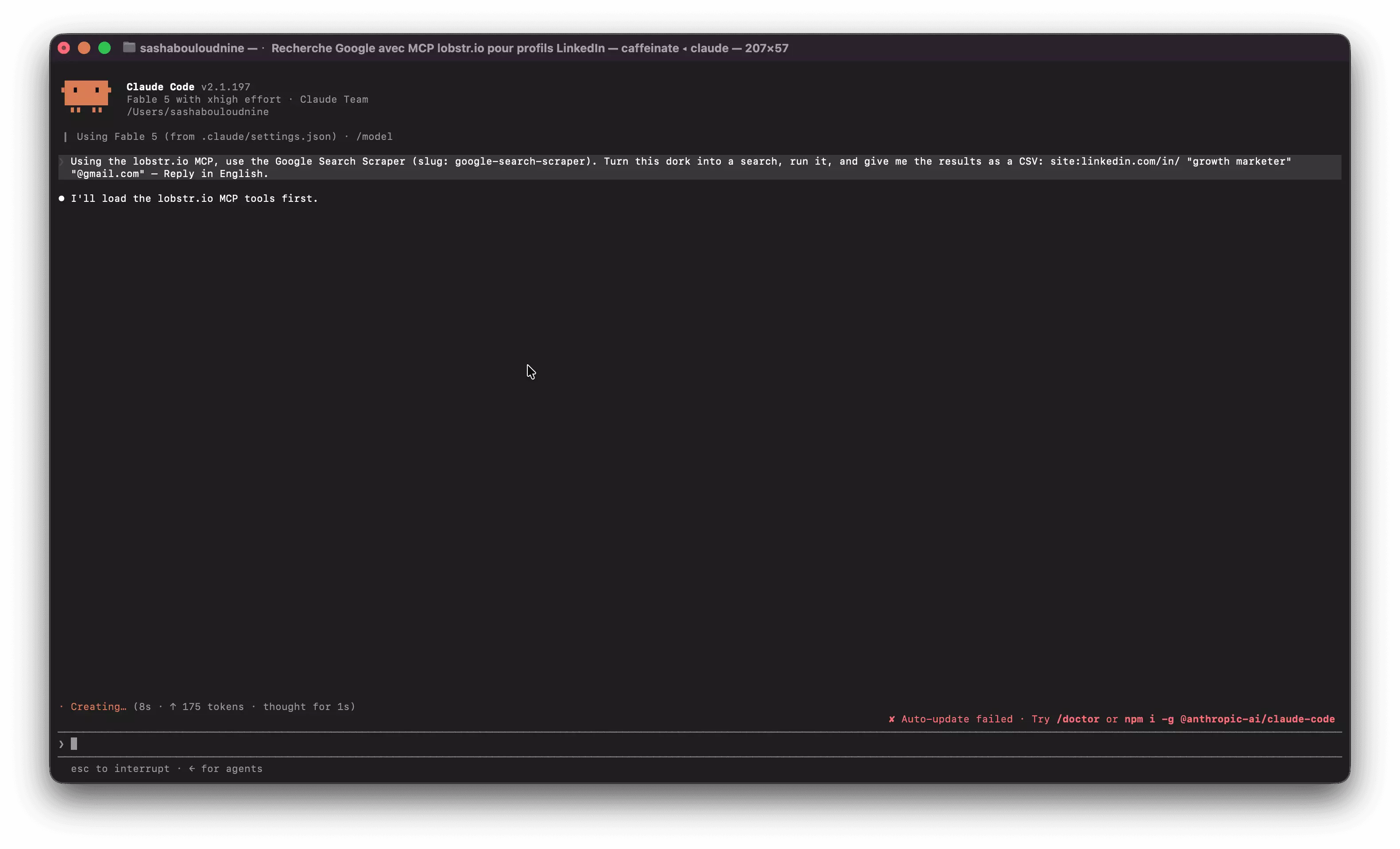
The scraper rotates proxies and solves the CAPTCHAs that stop a manual or agent-chat workflow cold at volume. You paste the dork; it deals with the blocking.
Powerful enough that a fair question follows: are you actually allowed to do this?
Is this legal?
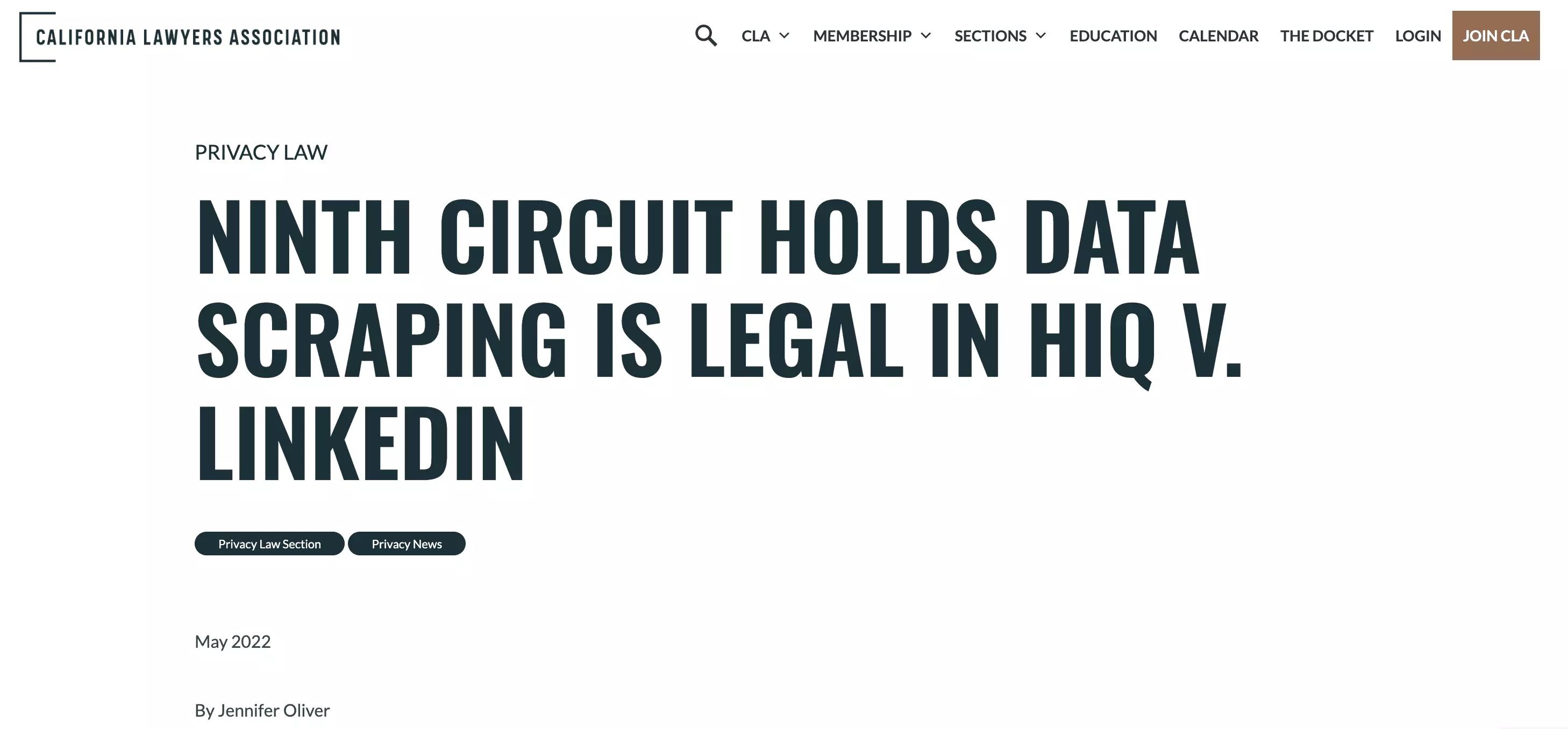
But terms of service still bind you. hiQ ultimately lost — not on hacking grounds, on breach of contract.
It had LinkedIn accounts, so it had agreed to LinkedIn's terms. The 2022 judgment ended in a permanent injunction plus a 500,000 dollar payment.
The lesson maps straight onto this guide: work from Google's public index, logged out, and you never agree to LinkedIn's terms in the first place.
In July 2026 a federal judge threw the claim out, ruling Google can't weaponize copyright to block the scraping of uncopyrighted web data.
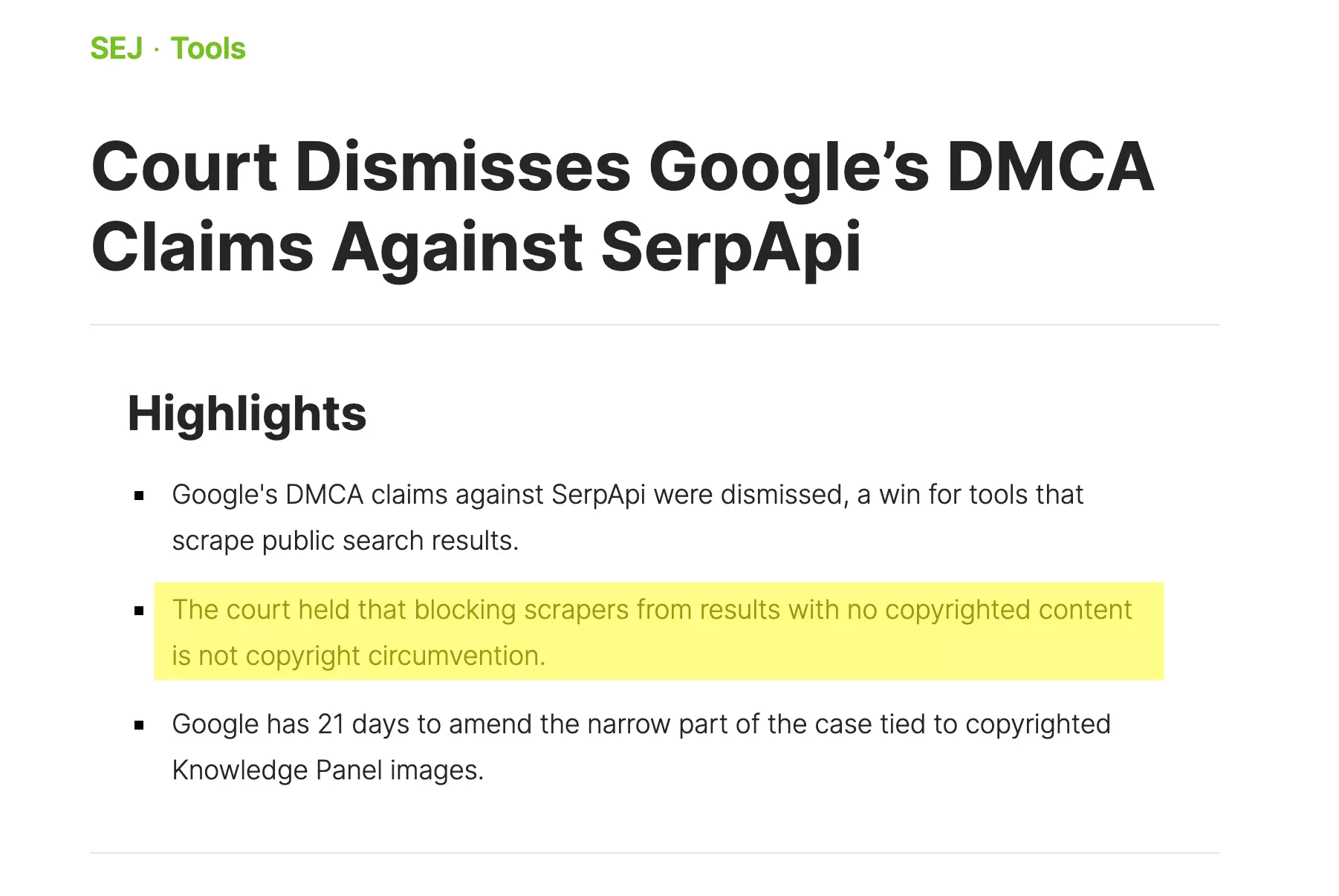
Google amended its complaint in August, so it isn't fully over — but the core theory lost.
On privacy, treat what you store like the business data it is.
None of this is legal advice. Operating at real scale, or in a regulated industry? Run the workflow past your legal team first.
The method has edges too. Knowing them tells you when to switch tools.
The limits of the Google method
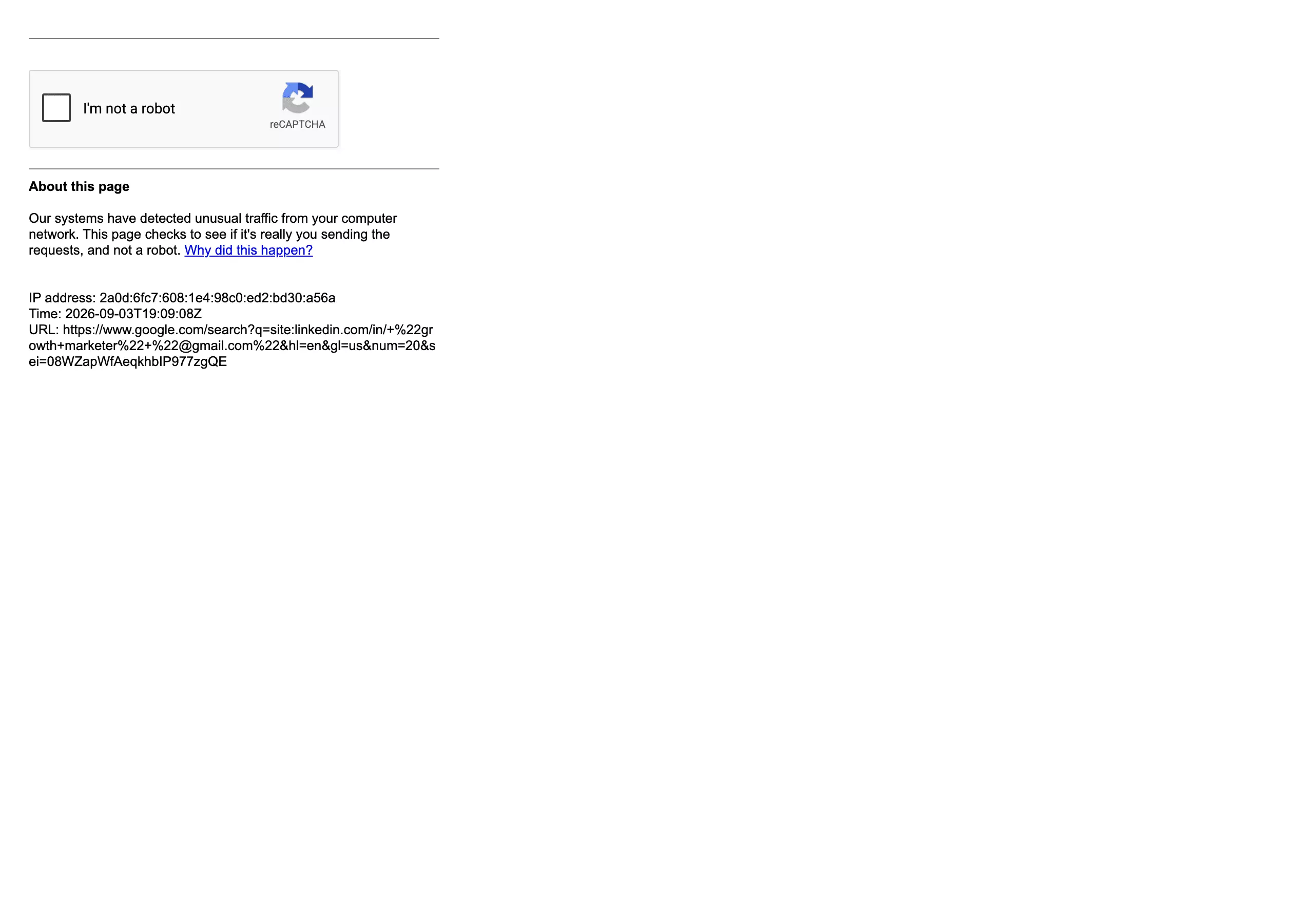
Any single query also tops out at a few hundred results. For a big market, split the dork by city or role and run the variants.
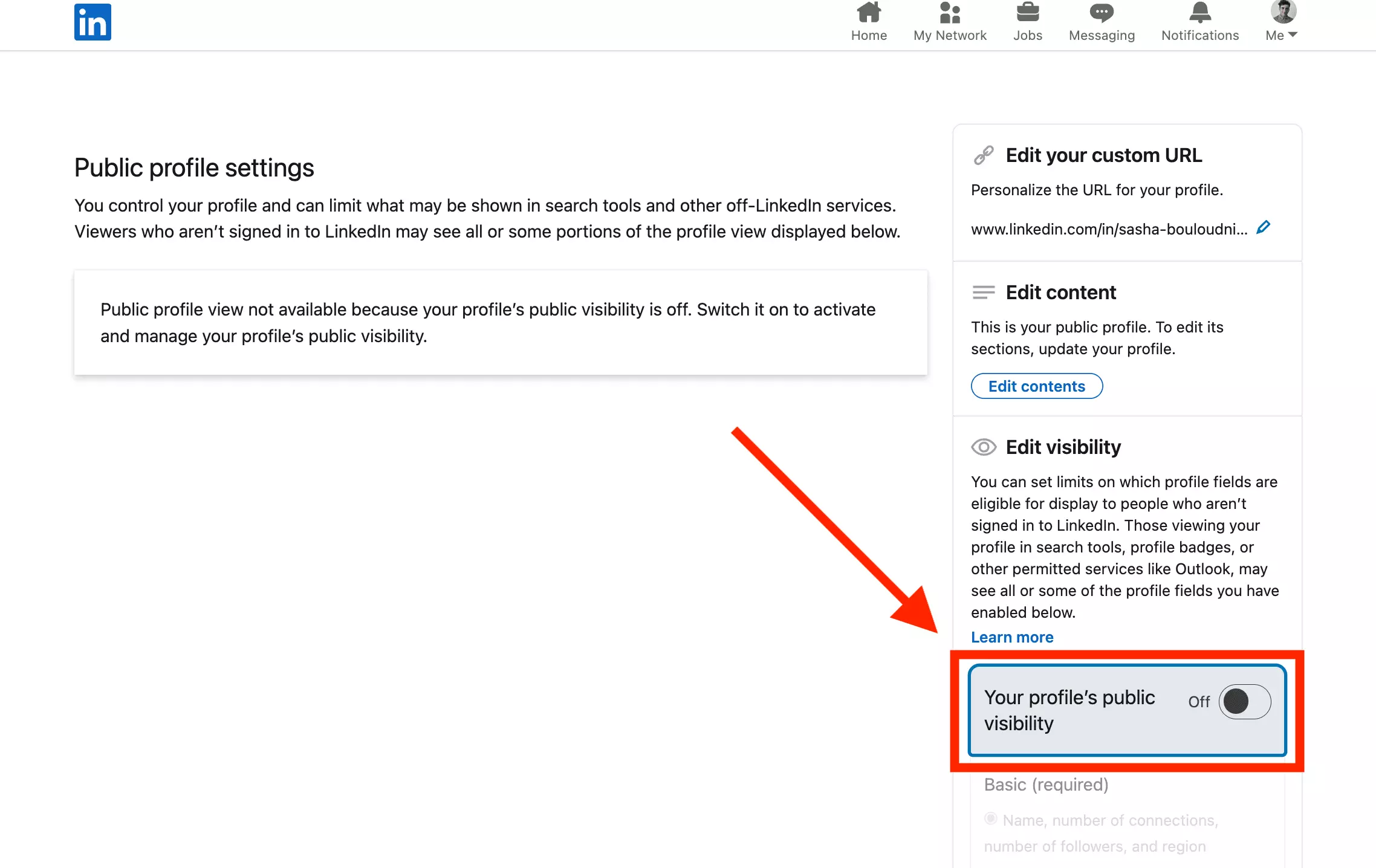
Profiles set to block search engines never appear at all — Google can only show what it's allowed to crawl.
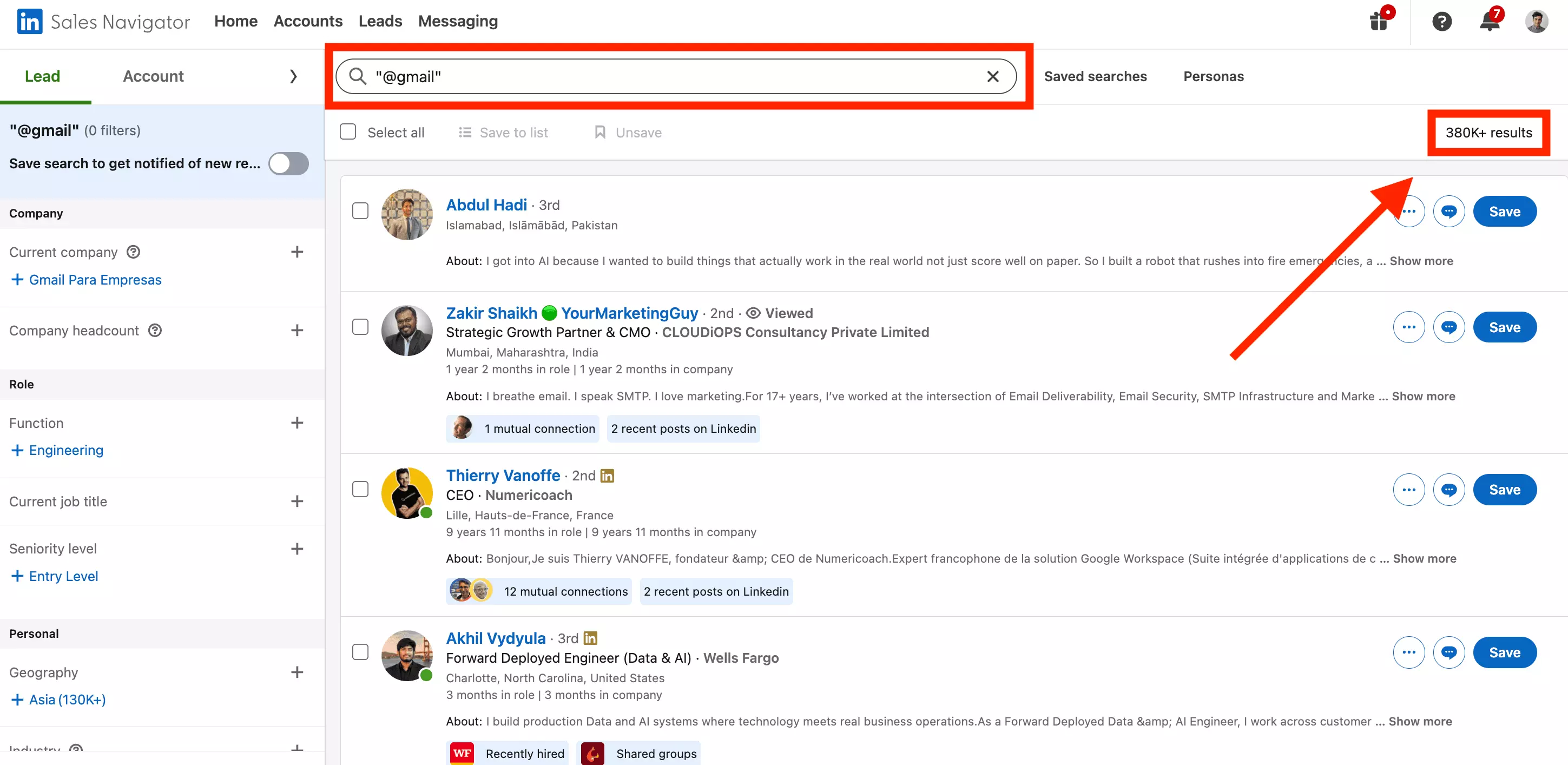
And the honest ceiling is the email itself.
"@gmail" alone returns about 384,000 profiles, and adding Yahoo, Hotmail, iCloud and AOL lands around 635,000 — against LinkedIn's billion-plus members, well under one percent.That count even runs low: Sales Nav's keyword search misses profiles I verified by hand. Double it for the misses and you still stay under one percent.
We also checked who those rare publishers are, across 2,000-plus profiles our runs collected.
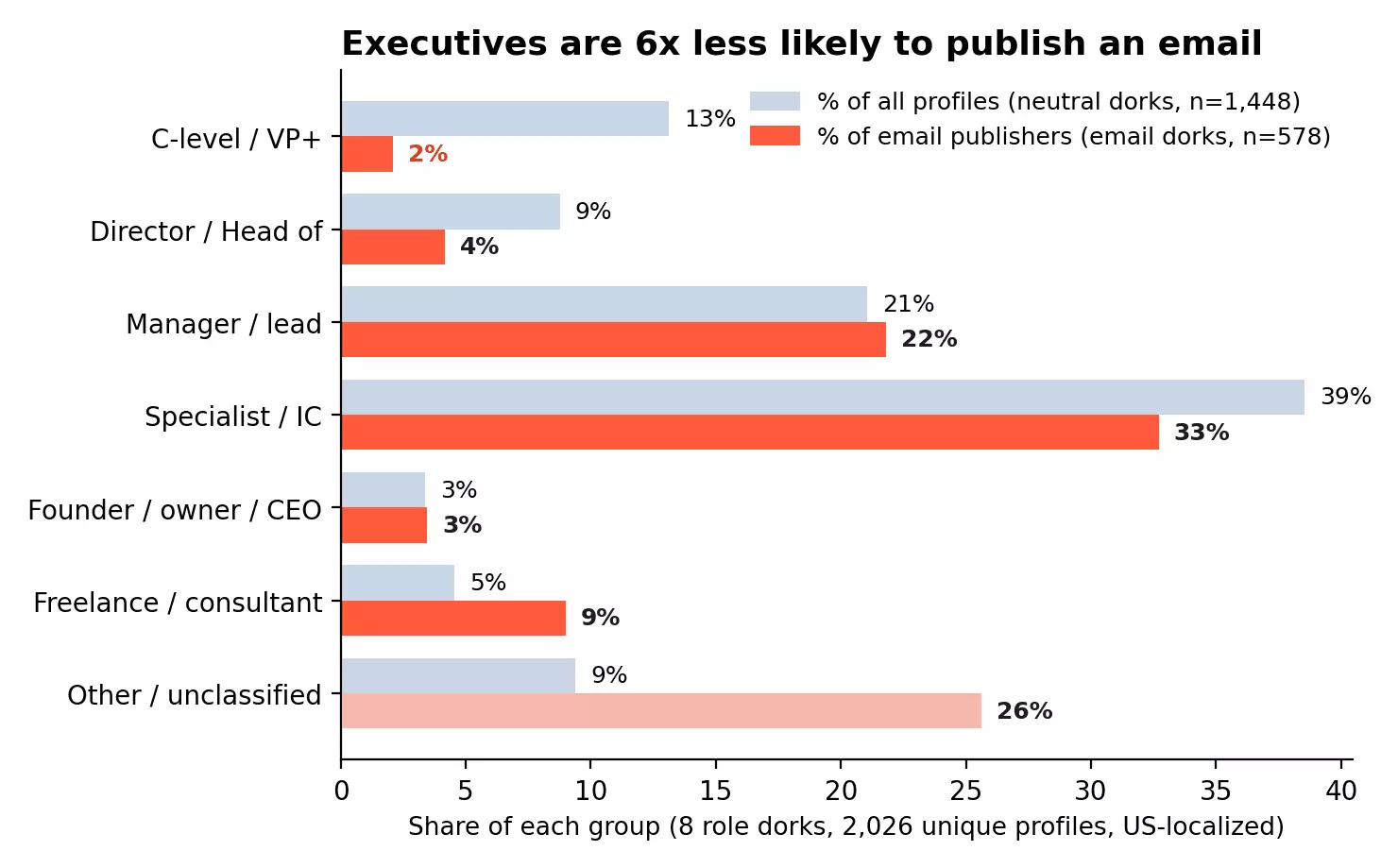
Executives made up 13% of the crowd but 2% of the publishers. Freelancers and consultants doubled their share — people who want inbound.
The skew is geographic, too: publishers over-index in India, Nigeria, and Pakistan, even in our US-localized runs.
Before you fire off your first dork, the questions everyone asks:
FAQ
Can someone tell if I find their LinkedIn profile through Google?
No. Reading the Google result — title, snippet, even the indexed page — leaves no trace. LinkedIn only logs a view when you open a profile while signed in, which is the whole point of working from Google's index.
Does "@gmail.com" really work as a search filter?
"@gmail.com" straight into the query and Google matches the literal string in a profile's public text. (The intext: variant returns nothing — skip it.)Can I get corporate emails this way?
How many results can one dork return?
A few hundred. Google caps every query there. Split the dork by city or role to go wider — or run it through the scraper, which paginates to the cap for you.
Is X-ray search against LinkedIn's terms?
Not if you stay logged out. You only agree to LinkedIn's terms by creating or using an account. Google's public index never puts you under that contract — the distinction that decided hiQ v. LinkedIn.
Why are so many LinkedIn profiles on Google in the first place?
Why doesn't my own profile show up on Google?
Final thoughts
Google already did the hard work: it indexed a billion-plus LinkedIn profiles and left them sitting one dork away, no login required.
site:linkedin.com/in/ "sasha bouloudnine"f